Lot No. LOT-4342 · offered October 9, 2026
Precision Agriculture & AgTechLot sheet
UGA's 19th GRA Eminent Scholar Builds Plant Sensors to Flag Drought, Disease Early
UGA's 19th current GRA Eminent Scholar, Liang Dong, builds leaf-level sensors that detect reactive oxygen species, phytohormones, volatiles and nutrient levels in real time to flag drought, disease and insect stress before visible damage.
Market notes
- Liang Dong is UGA's 19th current Georgia Research Alliance Eminent Scholar, with a joint appointment in CAES and the College of Engineering.
- Dong's sensors detect reactive oxygen species, phytohormones, volatiles, nutrient levels, transpiration and photosynthetic activity in real time on or near the plant.
- Dong joined UGA after nearly two decades of Midwest sensor research and is in his first year as associate director for research at the Institute for Integrative Precision Agriculture.
- Grower priorities identified by Dong during his first year include crop biosecurity and drought-related water management across Georgia's hot, humid and coastal production zones.
- GRA is a nonprofit public-private partnership that recruits researchers to Georgia universities and provides seed funding to move university discoveries to market.
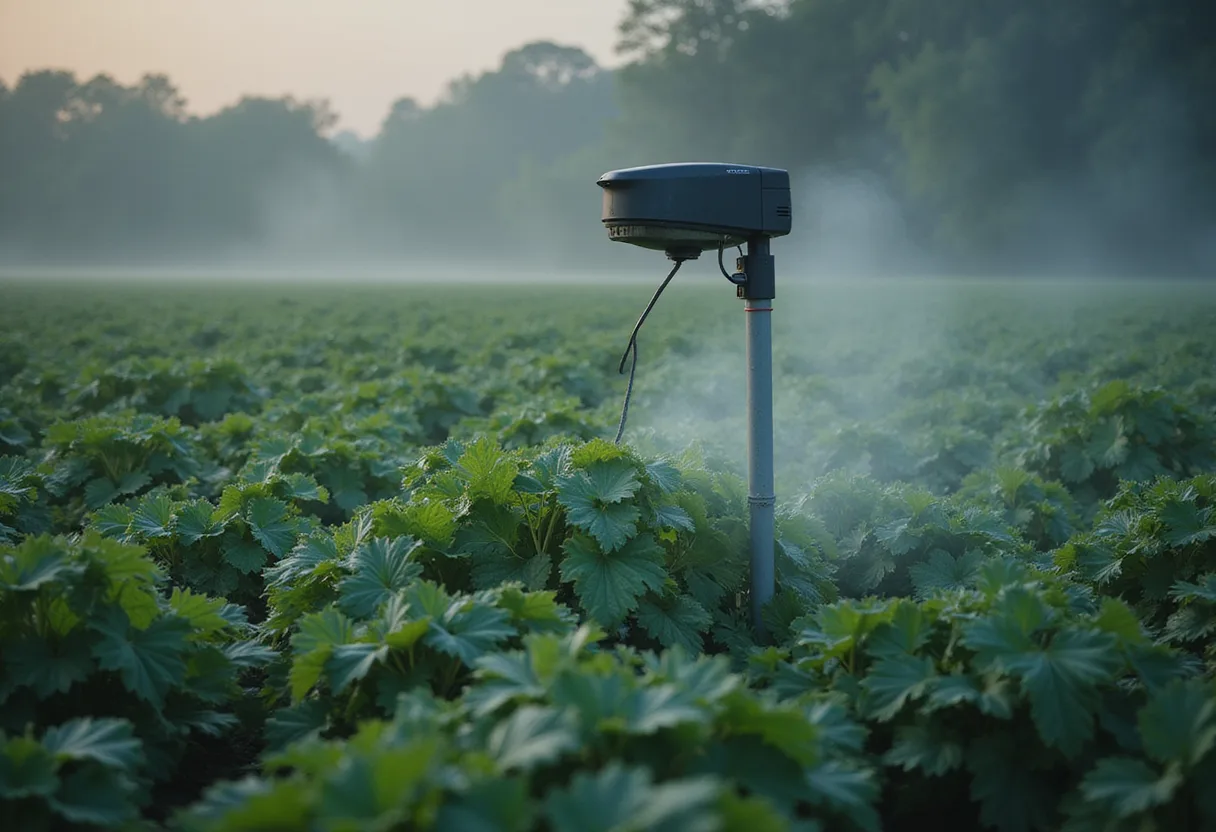
University of Georgia researcher Liang Dong, the state's 19th current Georgia Research Alliance Eminent Scholar in Precision Agriculture, holds a joint appointment in UGA's College of Agricultural and Environmental Sciences and College of Engineering, and serves as associate director for research at UGA's Institute for Integrative Precision Agriculture.
The post marks Dong's first year in the interdisciplinary role, following nearly two decades of sensor work in the Midwest. He came to Georgia to develop hardware that reads drought, disease and insect stress directly from plant biochemistry — before fields show damage visible to scouts or drones.
What signals do the sensors read?
Dong's lab designs sensor arrays placed on or near the plant to measure biochemical and physiological signals in real time. Detection targets include reactive oxygen species, phytohormones and volatiles — compounds that form an interconnected signaling network regulating plant growth, development and stress response.
The same platforms also measure nutrient levels, transpiration and photosynthetic activity, Dong said, giving growers an earlier picture of plant status than visual scouting offers. Earlier detection matters because disease, insect feeding and drought stress leave biochemical fingerprints before leaves yellow, wilt or curl.
"Instead of waiting until we can see that something is wrong, the sensor lets the plant tell us what it is experiencing," Dong said. "In a sense, we are giving plants a voice."
How does this connect to input costs?
For row-crop and specialty-crop operations, the practical question is margin. Earlier stress detection translates directly into tighter irrigation, fertilizer and pesticide timing, Dong said — the categories that dominate variable costs for Georgia cotton, peanut, soybean and vegetable growers.
In conversations with growers and UGA Cooperative Extension specialists during his first year, Dong identified two priorities: crop biosecurity and drought-related water management. Both carry direct cost implications when scouts miss early symptoms and treatment windows close.
"We want to know whether sensors can detect how a plant is responding to these threats before we can see visible symptoms," Dong said. "If we can do that, sensors could provide an early warning and help growers respond much faster. More data can help growers make more precise irrigation decisions and use water more efficiently."
Why is Georgia the testbed?
Georgia's drought-prone, hot and humid climate creates one set of pressures. The state's coastal environments add salinity stress on top of pests and disease. Dong frames that variability as an asset for sensor validation across crops and conditions.
"These different conditions make Georgia a great place to develop and test sensors that can identify multiple types of stress and help us adapt precision-agriculture technologies to different crops and production environments," Dong added.
The Institute for Integrative Precision Agriculture serves as the hub connecting engineering, plant and animal sciences, AI and data science, Extension and economics — disciplines Dong called a natural connector for the work.
What comes after the lab?
Dong's near-term goals extend beyond row crops. He sees parallel sensing applications for Georgia poultry, livestock and forestry operations, each facing distinct monitoring challenges around water, feed conversion, biosecurity and disease pressure.
His stated benchmark for success is sensor outcomes, not sensor count: better decisions, higher productivity, greater resilience and lower use of water, fertilizer and pesticides. Meeting that bar requires pulling raw signals into recommendations growers can act on without specialist interpretation.
"Agriculture is biological, environmental, technological and economic all at the same time," Dong said. "An engineer can build a very sensitive sensor, but we need plant or animal scientists to tell us what signals really matter. We need agricultural scientists and Extension specialists to tell us what is practical. And we need AI and data science to help turn all that information into useful decisions."
GRA, a nonprofit public-private partnership, recruits researchers to Georgia universities, funds lab enhancements and provides seed capital to move discoveries to market. Dong's chair sits inside that recruitment track — institutional backing that signals continued investment in precision-agriculture infrastructure at UGA through the GRA portfolio.
The next step, Dong said, is continuous sensing systems that translate plant-level signals into management recommendations, with field trials positioned across multiple Georgia crops and production environments.
via fieldreport.caes.uga.edu (Original)
More from Marcus Bennett
Show full bio
Senior reporter covering regulation, policy and their impact on Agribusiness coverage for industry professionals at Agribusiness Wire.
413 articles
Also in the yard
- Nature review maps bioelectronics path from lab bench to field
- What Satellite Imagery Can and Cannot Tell Growers About Crop Health
- PlantVoice Brings 'Plant Intelligence' to Precision Agriculture
- Auburn Calibration Push Targets On-Farm Input Efficiency
- Tennessee taps Argentine-trained engineer to test precision ag ROI on row crops